From Rhythm to Vocabulary: How Irish Music & Dance Help Language Learners Connect
When students travel abroad to learn a language, they’re not just looking for lessons in a classroom. They’re searching for new experiences—moments that bring the language to life. And I see it every week: groups of excited young people stepping off buses in Dublin, wide-eyed and curious. They’ve studied English in textbooks and practiced vocabulary in their school halls, but the question they quietly carry with them is always the same:
“What will we do here that we’ll truly remember?”
At The Irish Dance Party, we’ve built our entire experience around answering that question. Because we believe that language learning shouldn’t be confined to worksheets and grammar charts. It should happen while laughing, while moving, while trying something new and feeling like part of a story bigger than yourself.
Music and dance are universal human languages—every culture has them, every student relates to them. That’s why our show isn’t just entertainment; it’s a bridge. A connection point where English becomes more than words on a page. Where language blends seamlessly with rhythm, physical movement, and live cultural expression.
Why Music and Dance Matter in Language Learning
Traditional language teaching often focuses on vocabulary lists, grammar drills and structured exercises. But research and experience show that learning accelerates when multiple senses and modalities engage: hearing, seeing, doing. Music and dance offer exactly that
At The Irish Dance Party we bring in:
- Live traditional Irish music and instruments (fiddle, tin whistle, bodhrán).
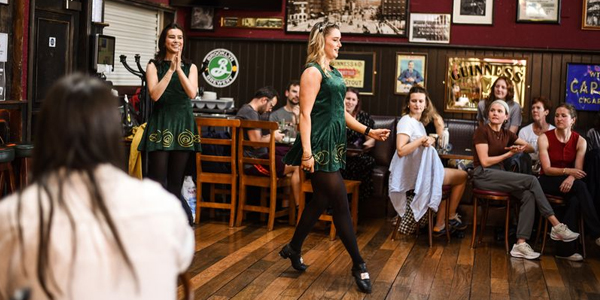
- Professional Irish dancers who perform and then teach steps to the group.
- A setting where students from language schools are invited to participate, learn, move and enjoy in a fun, inclusive environment.
By combining auditory (music), visual (dance), kinesthetic (movement) and social (group) learning channels, the experience creates stronger cognitive and emotional connections. New vocabulary and concepts aren’t just heard—they’re felt. A rhythm becomes a movement; a word becomes a step; a phrase becomes a part of the body’s memory.
How We Facilitate the Connection: Our Student Activity Structure
Here’s a breakdown of how we set up the experience for language-school student groups:
1. Introduction & Context
We begin by welcoming the group and introducing the music and dance tradition. Our musician-host sings lively Irish songs and explains the instruments, the history and the culture behind them in a fun, humorous way.
This context gives students a frame of reference: they understand why they are doing this, not just what. It links music and dance to cultural storytelling, which is rich in vocabulary about instruments, history, and actions.
2. Professional Performance
The students watch a professionally choreographed dance performance, paired with live music. This serves as both entertainment and model: how the steps are executed, how the music flows.
This visual modelling helps learners see movement-words in action, for example: “slide,” “shuffle,” “leap,” “clap,” “turn”. These are often the same vocabulary items you teach in language classes—but here they are embedded in real culture.
3. Interactive Teaching & Participation
After the performance, the students get to learn selected Irish dance steps—three simple dances: 20 minutes, 20 minutes, 10 minutes.
During these segments:
- Students physically perform the movement, linking body + word + meaning.
- The host continues commentary, stories and questions in English, so students hear and practise listening. Because it’s lightweight, fun and inclusive, even students with limited language competence can engage without pressure. Their confidence increases.
4. Cultural & Social Engagement
The venue is friendly, fun and multimodal: the students are seated at reserved tables, can relax, chat, and enjoy the atmosphere.
The setting fosters peer interaction: students ask each other questions, laugh at stumbles, compare their steps, and thus practice English socially (“How did you do that?”, “Watch me try this step”, “This is fun!”). Also, the musician shares stories about the songs and dance, enriching cultural vocabulary and context.
Social bonding, enjoyment and cultural immersion create emotional memories, and emotional memory enhances language retention.
Key Language‐Learning Benefits
Let’s look at how music & dance translate into concrete language-learning gains:
Vocabulary and Action:
- Students hear words in context and immediately perform them. This kinesthetic link strengthens retention.
- Cultural vocabulary: Instruments, dance style names, Irish song titles—all provide rich lexical sets beyond everyday classroom topics.
- Listening practice: Musicians speak and sing, dancers count, host gives instructions—students practise interpreting spoken language in real time.
- Speaking & interaction: Students may answer prompts, ask questions, and comment on their performance.
- Confidence & fluency: Because the setting is informal and fun, language use becomes less intimidating and more spontaneous.
Cultural Understanding and Context:
- Students learn not just the “what” of steps, but the “why” of tradition: the stories behind songs and movements. This deepens their cultural competence, which is a key dimension of language competence.
- They experience Irish culture live—not from a textbook—but in situ: music, dance, communal experience.
Memory & Motivation:
- Because the experience is physically embodied and emotionally rich, it sticks. Movement + music = stronger memory anchors compared to rote learning.
- Motivation increases: students remember the “wow” of the moment and are more likely to keep engaging with English (and culture) afterward.
Group Dynamics & Peer Learning:
- Shared experiences strengthen group cohesion. As the event page notes, our activities are designed for student groups “of all ages” and to keep them engaged.
- Peer support emerges: students help each other, laugh together, discuss what they’re doing—which generates informal use of English.
Practical Tips for Language Educators
If you’re planning to bring your students to The Irish Dance Party (or replicate a similar immersive cultural-language activity), here are recommendations:
- Pre-brief students: Introduce vocabulary ahead of the session (step, tap, shuffle, instrument names) so they feel prepared.
- Encourage participation: Emphasise that the aim is fun and movement—not perfection. This mindset reduces anxiety and increases engagement.
- Link to classroom work: After the session, ask students to reflect: what new words did they hear? Which dance step matched which instruction? Which instrument did they recognise?
- Follow-up activity: Use the experience as a springboard—ask students to describe the event in English, write about their favourite moment, or research one Irish instrument they heard.
- Group discussion: Have students share with each other: “What was your favourite part?” or “Which word did you notice the most?” This fosters peer language use.
- Contrast cultures: Use the event to spark discussion: “How is music and dance used in your country? Is there something similar?” This promotes higher-order thinking and comparative language.
Final Thoughts
In the world of language education, the best experiences are those that move beyond textbooks and into life. Through music and dance, The Irish Dance Party offers a learning environment that is not only engaging, but deeply human, sensory, social and memorable.
For language learners, the differences are real: vocabulary sticks, confidence grows, culture becomes alive. For educators, the benefits are significant: a well-organised activity that bridges fun and learning, strengthens the student group, and embeds cultural competence into language education.
In short: when students move to a rhythm, hear a story, tap their feet, laugh together—they aren’t just studying English, they’re living English in Irish culture. And that connection matters.
If you’re arranging a language-school trip to Dublin (or considering an off-site cultural activity), I highly recommend making The Irish Dance Party part of your itinerary. It’s more than a show—it’s a language-learning experience disguised as fun.